Equalizer RV Leveling System Troubleshooting: Quick Fixes
If your Equalizer RV leveling system will not extend, will not retract, shows an error, or leaves the motorhome uneven, start with power, safety, and fluid checks. Most faults come from low battery voltage, a blown fuse, a poor ground, a blocked hydraulic valve, low fluid, or an incorrect leveling sequence.
This guide applies to many Equalizer Systems hydraulic leveling systems used in RVs across the United States. Exact buttons, lights, fuses, and reset steps can vary by model. Always compare these steps with the owner’s manual for your control panel and RV.
Do not work beneath an RV that is supported only by leveling jacks. Use approved jack stands and follow the RV maker’s safety rules.

How an Equalizer RV Leveling System Works
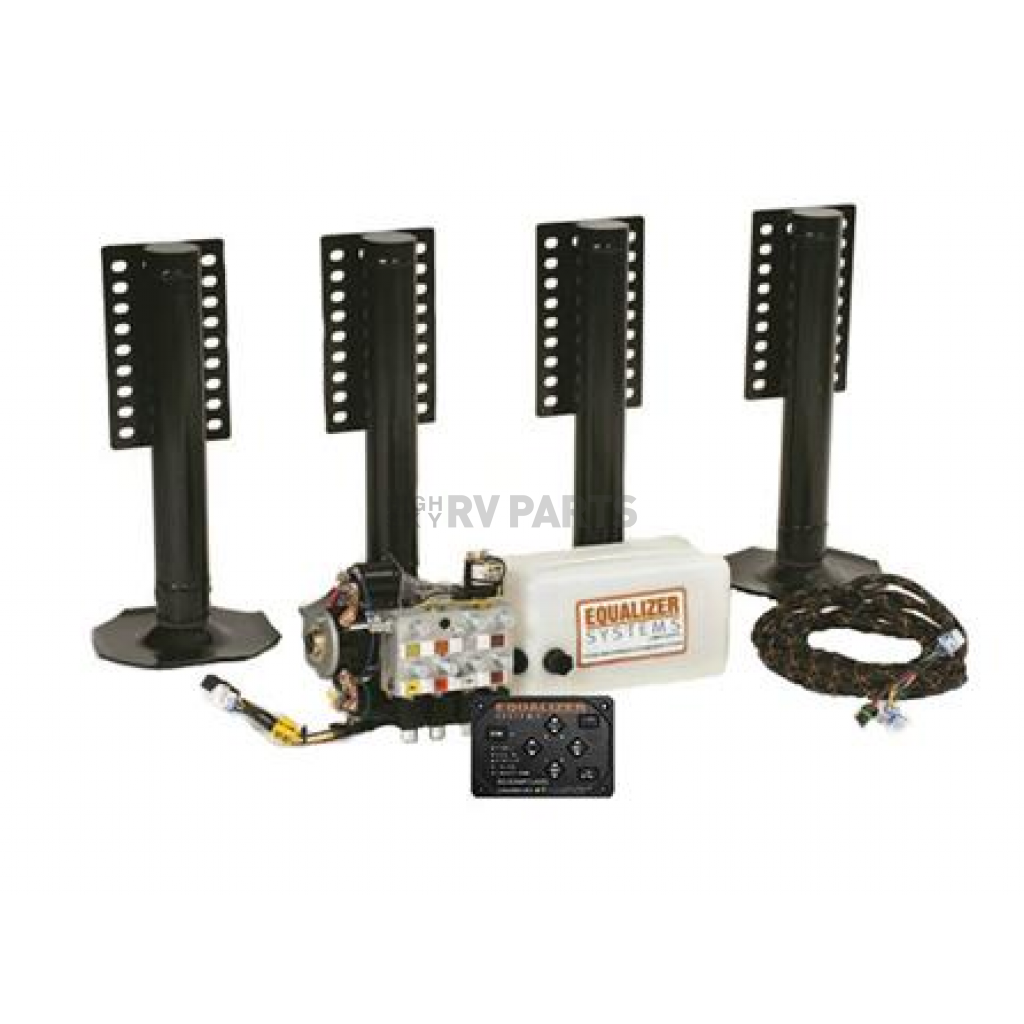
An Equalizer hydraulic leveling system uses a control panel, a pump motor, hydraulic fluid, valves, hoses, and leveling jacks. The control panel sends power to the pump and valves. The pump then moves fluid to extend or retract the jacks.
The system may have:
- A touch-pad or wall-mounted control panel
- A hydraulic pump and fluid reservoir
- Front and rear leveling jacks
- Solenoid valves
- Fuses, relays, and circuit breakers
- Battery power and ground cables
- A level sensor or internal leveling program
The jacks support and level the RV. They are not a replacement for the RV’s parking brake, wheel chocks, or approved support stands.
Hydraulic versus electric leveling systems
Many Equalizer Systems use hydraulic jacks. Some RVs may have electric jack systems or a system supplied under a related brand. Before troubleshooting, confirm which system is installed.
A hydraulic system often has:
- A pump motor
- Hydraulic hoses
- A fluid reservoir
- Hydraulic cylinders
- A manifold with valves
An electric system usually has:
- Individual electric motors
- Gear drives
- Wiring at each jack
- No central hydraulic pump or fluid tank
Do not add hydraulic fluid to an electric system. Do not use electric-jack troubleshooting steps on a hydraulic system.

Safety Checks Before Troubleshooting
Park the RV on firm, level ground before testing the system. Set the parking brake, place the transmission in Park, and use wheel chocks. Keep people away from the jacks while they move.
Before touching the system:
- Turn off the engine unless the owner’s manual says it should run during operation.
- Keep hands, feet, tools, and clothing away from moving jacks.
- Never place any part of your body under the RV while it is held up by the leveling system.
- Wear eye protection when checking hydraulic lines or fittings.
- Treat hydraulic fluid as pressurized. A pinhole leak can injure skin.
- Stop if a jack is bent, damaged, leaking heavily, or pulling away from its mounting point.
If the RV is unstable, one jack is lifting a wheel, or the system is making a sharp grinding sound, stop the test. A qualified RV technician should inspect it.

Quick Diagnostic Order
Follow the checks in this order. Start with the easiest and safest checks before testing valves or hydraulic parts.
- Confirm the RV is parked safely.
- Check the battery voltage and battery connections.
- Inspect the system fuse, breaker, and ground cable.
- Check the control panel for power and error lights.
- Inspect the hydraulic fluid level.
- Look for leaks, loose wires, and damaged hoses.
- Test the pump motor and solenoid valves.
- Reset or recalibrate the system only when the manual supports it.
- Call an RV service professional if the fault remains.
This order helps prevent a common mistake: replacing a pump when the real problem is a weak battery or bad ground.
Basic tools that may help
You may need:
- A digital multimeter
- A flashlight
- A socket and wrench set
- Clean rags
- The correct hydraulic fluid listed in the manual
- A small inspection mirror
- Replacement fuses of the same rating
Do not install a larger fuse to stop it from blowing. A larger fuse can damage the wiring or create a fire risk.

Equalizer Leveling System Does Nothing
If the panel is dark and no jack moves, check the main power supply first.
Likely causes
- The battery is discharged.
- The battery disconnect is off.
- The system fuse is open.
- A circuit breaker has tripped.
- The ground cable is loose or corroded.
- The parking brake or transmission safety signal is missing.
- The control panel has lost power.
- A control-board connection is loose.
What to check
- Turn on the RV’s interior lights. Dim lights may point to a weak battery.
- Inspect the battery terminals. They should be clean and tight.
- Check the main power cable at the pump and control box.
- Inspect the fuse and circuit breaker listed in the RV or Equalizer manual.
- Check the ground cable from the battery to the chassis and pump area.
- Confirm the parking brake is set and the transmission is in Park.
- Turn the system off, wait a short time, and try again.
A battery can show normal voltage with no load and still fail when the pump starts. If the panel works but the motor clicks or slows, test voltage while the system is under load.
When a multimeter helps
Set the meter to DC volts. Check the voltage at the battery first, then check the power connection at the pump while someone operates the system.
A large voltage drop between the battery and pump suggests a poor cable, bad connection, weak ground, or damaged relay. The exact acceptable voltage depends on the system voltage and the manufacturer’s specifications. Use the service manual for the limit.

The Leveling Jacks Will Not Extend
When the control panel works but the jacks do not extend, the fault may be in the pump, valve circuit, wiring, or hydraulic system.
Possible causes
- Low battery voltage
- A pump relay or fuse problem
- A failed pump motor
- A stuck hydraulic valve
- Low fluid
- A damaged hose
- A control-panel or control-board fault
- The system is still in a retract or travel mode
Troubleshooting steps
- Confirm the panel recognizes the extend command.
- Listen for the pump motor.
- If the motor is silent, check power at the motor and relay.
- If the motor runs but the jacks do not move, check fluid level and valve operation.
- Inspect the hoses and fittings for wet spots.
- Look at each jack for dents, dirt, rust, or physical damage.
- Make sure the jack foot is not trapped against an obstacle.
If the motor runs but only one jack fails, the problem may be limited to that jack, hose, or valve. If all jacks fail together, look first at the pump, power supply, hydraulic fluid, or main control circuit.
Do not force a jack down with a pry bar. This can damage the cylinder, mounting bracket, or frame.

The Jacks Will Not Retract
A jack that will not retract can prevent travel and may cause serious damage if the RV is driven.
Common causes
- Low battery voltage
- A retract solenoid or valve problem
- A clogged or restricted hydraulic return path
- A damaged hose
- A bent jack
- Dirt or corrosion around the jack shaft
- A control-panel fault
- A manual-release valve that is not in the correct position
Safe steps
- Park on firm ground and chock the wheels.
- Confirm the pump has adequate power.
- Inspect the jack for a bent shaft or physical obstruction.
- Check the hydraulic reservoir level.
- Look for leaks near the jack, hose, manifold, and pump.
- Use the automatic retract function exactly as described in the manual.
- If the system has a manual retract procedure, follow only the model-specific instructions.
Many systems use manual valves or release methods that differ by model. Opening the wrong valve can allow a jack to drop or make the RV unstable. Do not loosen hydraulic fittings to release pressure.
If a jack remains extended, have an RV technician handle the manual retraction when the owner’s manual does not give a clear procedure.

The RV Is Not Level After the System Runs
An RV can have fully extended jacks and still not be level. This may happen because the starting position was poor, the ground slopes sharply, or the level sensor needs calibration.
Check the setup
- Park the RV in the safest level area available.
- Keep the front wheels pointed straight when practical.
- Set the parking brake.
- Follow the correct automatic or manual leveling sequence.
- Do not place a tire completely off the ground unless the RV maker specifically allows it.
- Use leveling blocks under the jacks if the system manual permits them.
Leveling blocks can reduce jack extension and improve stability. Use blocks made for RV leveling. Do not use loose wood scraps, bricks, or unstable objects.
Check the level sensor
A level sensor tells the control system when the RV reaches its programmed position. If the sensor is loose, tilted, or out of calibration, the system may stop too soon or level the RV incorrectly.
Inspect the sensor only if it is accessible and the manual identifies its location. Do not move it by guesswork. A sensor adjustment usually requires a specific calibration process.
Some systems use a “zero point” or “null” setting. This is the stored position the controller treats as level. Recalibration can help after sensor service or control replacement, but an incorrect calibration can make every automatic cycle worse.

The System Shows an Error Light or Beeps
An error signal usually means the controller has detected an unsafe condition, a travel problem, or a sensor issue. The meaning depends on the exact model and display.
Common causes include:
- The parking brake is not detected.
- The transmission is not in the required position.
- A jack is not fully retracted.
- The system detects low voltage.
- A jack sensor or position switch is faulty.
- The control panel lost communication with the controller.
- The RV is not in the required travel mode.
Start by reading the error code in the Equalizer owner’s manual. Do not assume that the same light pattern means the same fault on every Equalizer system.
If the panel reports that a jack is down after retraction:
- Stop and inspect the jack.
- Confirm it is physically retracted.
- Check for a damaged sensor or wiring.
- Do not drive until the manual confirms the system is safe for travel.
- Have the system repaired if the warning returns.
Never bypass a travel warning just to get on the road.

The Pump Runs but the Jacks Move Slowly
Slow movement often points to low voltage, low fluid, restricted flow, cold fluid, or a worn pump.
Inspect these areas
- Battery charge
- Battery cables and grounds
- Hydraulic fluid level
- Fluid leaks
- Kinked hoses
- Damaged fittings
- Pump noise
- Jack condition
- Temperature and storage conditions
Hydraulic fluid can move more slowly in cold weather. A cold system may work slowly at first, but it should not leak, grind, or lose power. Use only the fluid type listed for the system. Mixing fluids can damage seals or change system performance.
If the pump becomes loud, the fluid foams, or the reservoir level falls quickly, stop operating the system. These signs may indicate air in the system, a leak, or a pump inlet problem.

The Pump Runs but the Jacks Do Not Move
When the motor runs but the jacks remain still, the pump may not be building pressure or the fluid may not be reaching the correct circuit.
Possible causes include:
- Low hydraulic fluid
- A failed pump
- A blocked inlet filter
- A stuck valve
- Air in the hydraulic system
- A loose or damaged hose
- A control valve problem
- A mechanical failure inside a jack
Check the fluid level and inspect for leaks first. If the fluid is full and no hose is damaged, the hydraulic manifold and pump need further testing.
Hydraulic pressure testing requires the correct gauge, fittings, and procedure. Do not place your hand near a suspected leak. Have a qualified technician test the system.

Hydraulic Fluid Leaks
A leak may appear as wet fluid around a jack, hose, fitting, manifold, or pump reservoir.
Small seep versus active leak
A light film of fluid may point to a loose fitting or worn seal. A drip, spray, or fast drop in fluid level is more serious. An active leak can make the jacks lose support.
Do not keep cycling the system to find the leak. Clean the area from a safe position, operate the system only if the manual allows it, and inspect for the new wet spot.
Do not tighten hydraulic fittings while the system is pressurized. Do not use tape or sealant where the manufacturer does not specify it. A damaged hose or cylinder seal usually needs replacement, not a temporary patch.
Hydraulic fluid can harm paint, rubber parts, and the environment. Clean spills according to local disposal rules.

A Simple Symptom and Cause Table
Use this table as a starting point, not as a substitute for the model manual.
| Symptom | First checks | Likely area |
|---|---|---|
| Panel is completely dark | Battery, fuse, ground, disconnect | Electrical supply |
| Panel works, but pump is silent | Relay, motor power, safety signal | Motor or control circuit |
| Pump clicks but does not start | Battery under load, cables, ground | Battery or motor circuit |
| Pump runs, no jacks move | Fluid level, leaks, valves | Hydraulic supply |
| One jack does not move | Hose, valve, jack damage | Individual circuit |
| Jacks move slowly | Battery, fluid, cold conditions, restrictions | Power or hydraulic flow |
| Jack will not retract | Obstruction, valve, hose, manual release | Retract circuit |
| RV stops uneven | Setup, blocks, sensor calibration | Level sensor or procedure |
| Travel warning remains on | Jack position, sensor, wiring | Safety or position circuit |
| Fluid appears near a jack | Hose, fitting, cylinder seal | Hydraulic leak |
The most useful clue is whether the fault affects one jack or the whole system. A whole-system problem usually points to shared power, the pump, the controller, or the fluid supply. A single-jack problem usually points to that jack, its hose, its valve, or its wiring.

How to Test the Battery and Ground
Electrical checks can find many leveling faults without removing hydraulic parts.
First, inspect the battery terminals and cables. Remove corrosion, tighten loose connections, and check for damaged cable ends. Make sure the ground cable connects firmly to clean metal.
Next, measure battery voltage with the system at rest. Then measure voltage again while the pump starts. A large drop during motor startup can indicate a weak battery, poor cable, bad connection, or failing motor.
Test the positive and ground sides separately. Place one meter lead at the battery and the other at the pump connection. A voltage difference under load shows loss in the cable or connection path.
Use the exact limits in the Equalizer service information. Do not diagnose a motor from voltage alone. A motor may receive power yet have an internal fault, and a control circuit may show voltage without supplying enough current.

When to Reset or Recalibrate the System
A reset may clear a temporary controller fault. It will not repair a bad motor, broken wire, leaking hose, or damaged jack.
Before resetting:
- Retract the jacks if it is safe to do so.
- Turn off the control panel.
- Follow the model-specific power reset steps.
- Check the manual for stored settings or calibration instructions.
Recalibrate only when the RV is in a known level position and the manual gives the correct procedure. Use a reliable bubble level or digital level placed on a stable part of the RV. Do not calibrate on a slope.
If the system loses calibration again, look for a loose sensor, damaged wiring, low voltage, or a controller fault instead of repeating the calibration.

Common Mistakes to Avoid
Avoid these mistakes when troubleshooting an Equalizer RV leveling system:
- Driving with a jack even slightly extended
- Working under an unsupported RV
- Replacing a fuse with a higher-rated fuse
- Adding the wrong hydraulic fluid
- Opening a pressurized hydraulic line
- Forcing a stuck jack
- Moving the level sensor without a calibration procedure
- Using unstable blocks under a jack
- Assuming every Equalizer control panel works the same way
- Repeatedly cycling a system that is leaking or making grinding sounds
- Ignoring a low-voltage problem because the battery lights still work
A leveling system can appear to operate while still having a serious fault. Treat unusual noise, fast leaks, bent parts, and repeated error codes as reasons to stop.

When to Call an RV Technician
Professional service is the safer choice when:
- The RV is unstable.
- A jack is bent or detached.
- Hydraulic fluid is spraying or leaking quickly.
- The pump runs continuously.
- The system will not retract before travel.
- A fuse blows again after replacement.
- Wiring is hot, melted, or smoky.
- The control board or valve manifold needs testing.
- The system requires pressure testing.
- You cannot identify the correct manual retract procedure.
Give the technician the RV make, model, year, Equalizer system model, control-panel type, symptoms, error lights, and steps already completed. Photos of the control panel and hydraulic area can also help.

Frequently Asked Questions
Can I drive with Equalizer leveling jacks down?
No. Retract the jacks fully and confirm the travel warning has cleared before driving. A partially extended jack can strike the road or damage the RV.
Why does my Equalizer leveling system work when plugged into shore power but not on battery?
The battery may be weak, discharged, poorly connected, or unable to supply enough current. Shore power may run the converter, which can hide a battery or cable fault.
What hydraulic fluid does an Equalizer system use?
Use the fluid listed in the owner’s or service manual for the exact system. Do not guess based on fluid color or use automotive fluid unless the manufacturer specifies it.
Can I use the leveling jacks to change a tire?
The leveling system is not normally a substitute for a properly rated RV jack and approved tire-changing procedure. Follow the RV and chassis manufacturer’s instructions.
How do I find the right Equalizer manual?
Look for the system model on the control panel, pump assembly, or service label. Match that model with the official Equalizer Systems documentation or ask an RV service center to identify it.
Key Takeaways
The safest Equalizer RV leveling system troubleshooting path is:
- Secure the RV and keep clear of unsupported areas.
- Check battery power, cables, grounds, fuses, and safety signals.
- Inspect fluid level, hoses, valves, and jack condition.
- Use the symptom pattern to separate electrical, hydraulic, and sensor faults.
- Follow the exact manual for resets, calibration, and manual retraction.
- Stop and seek professional help for leaks, damaged jacks, repeated fuse failures, or an unsafe RV.
A careful diagnosis is better than forcing the system to move. If the jacks will not retract or the RV does not remain stable, do not travel until the fault is repaired.