Lippert RV Leveling System Troubleshooting: Quick Fixes
Lippert RV leveling systems help level many fifth wheels, travel trailers, and motorhomes at campgrounds across the United States. When the system will not extend, retract, find level, or respond to the control panel, the cause is often simple: low battery voltage, a blown fuse, a poor ground, a blocked jack, or a lost zero-point setting.
Start with safety. Park on firm ground, set the tow vehicle brake, chock the wheels, and keep people away from moving jacks. Do not crawl under an RV supported only by its leveling system. Use the RV owner’s manual and the exact Lippert manual for your system before disconnecting wires or bypassing controls.
Quick Answer: How to Troubleshoot a Lippert RV Leveling System
Troubleshoot a Lippert leveling system in this order:
- Confirm that the RV is safely parked and the battery is charged.
- Check the system power switch, fuse, circuit breaker, and ground connections.
- Look for blocked, bent, dirty, or damaged jacks.
- Check the control panel for an error message or warning light.
- Try a full retract cycle, if the system allows it.
- Recalibrate the zero point only when the RV is truly level.
- Test the motor, pump, wiring, and sensors if the basic checks fail.
- Stop and call a qualified RV technician when the system could drop the RV, leak hydraulic fluid, or has damaged wiring.
The exact steps vary. Lippert uses several systems, including electric leveling systems, hydraulic systems, Ground Control systems, Ground Control TT, Ground Control 3.0, and OneControl-connected systems. A procedure for one model may not work on another.
First Identify the Lippert Leveling System
The fastest diagnosis starts with the system type. Electric systems use powered screw jacks or landing gear. Hydraulic systems use a pump, fluid reservoir, valves, hoses, and hydraulic cylinders.
Look for the following clues:
| What you see | Likely system type | Main parts to inspect |
|---|---|---|
| A motor on each jack | Electric | Motors, gears, wiring, fuses, hall sensors |
| One pump and hydraulic hoses | Hydraulic | Pump, fluid, valves, cylinders, battery |
| Front landing legs plus rear stabilizers | Fifth-wheel leveling system | Landing gear, rear legs, control board |
| Four or six powered legs with a touch panel | Automatic leveling system | Control panel, sensors, controller, power supply |
| Phone or RV screen control | OneControl-equipped system | App connection, network, controller, panel |
Find the model name on the control panel, inside the battery compartment, near the pump, or in the RV documentation. Common names include Ground Control, Ground Control 3.0, Ground Control TT, Level Up, and OneControl.
Do not assume that every Lippert panel uses the same error codes. The button layout, reset method, calibration process, and wiring can differ by model and RV build date.
Safety Checks Before You Touch the System
A leveling problem can become a crushing hazard if the RV moves unexpectedly. Complete these checks before electrical or mechanical troubleshooting:
- Park on firm, reasonably flat ground.
- Place the transmission in Park or in the required tow position.
- Set the parking brake.
- Chock the RV wheels on both sides.
- Disconnect the tow vehicle only when the RV procedure allows it.
- Keep children, pets, and bystanders away from the jacks.
- Do not place any part of your body under the RV.
- Do not use leveling jacks as a substitute for approved support stands.
- Do not lift a tire off the ground unless the Lippert instructions for that system allow it.
- Wear eye protection when checking hydraulic lines or batteries.
If a hydraulic hose is leaking, shut the system off. Hydraulic fluid under pressure can penetrate skin. A leak needs professional repair, even if the system still appears to work.
If a jack is bent, twisted, cracked, or pulling away from the frame, do not operate it. A damaged jack can fail under load.
Lippert Leveling System Has No Power
When the panel is blank or nothing moves, check the power path first. A silent system often has a power problem rather than a failed jack.
1. Check the RV battery
A weak 12-volt battery may power lights but still fail under the heavy load of a leveling motor or hydraulic pump. Check the battery voltage with a multimeter when the system is off, then check it again while you press a leveling button.
A voltage reading near 12 volts does not prove that the battery is healthy. The voltage may collapse under load if the battery is discharged, damaged, or has a bad connection.
Inspect:
- Battery state of charge
- Battery terminals
- Main positive cable
- Main negative cable
- Frame ground connection
- Corrosion or loose fasteners
- Battery disconnect switch
Clean corrosion only after turning off the proper power sources. Tighten connections securely, but do not overtighten battery terminals.
2. Check the fuse and circuit breaker
Lippert systems often use a high-current fuse or circuit breaker near the battery, controller, or hydraulic pump. Some RVs also have a smaller fuse for the control panel.
Look for:
- A blown fuse
- A tripped automatic breaker
- A loose fuse holder
- Heat damage
- Melted insulation
- A breaker that trips again after reset
Replace a fuse only with the same type and rating. Never install a larger fuse to keep the system running. A larger fuse can allow wiring to overheat and create a fire risk.
3. Check the control-panel connection
A loose connector can make the panel appear dead or cause intermittent operation. Inspect the plugs at the control panel and controller. Look for moisture, bent pins, pulled wires, or green corrosion.
Do not probe sealed connectors with oversized test leads. Follow the wiring diagram for the exact system.
A Lippert Jack Will Not Extend or Retract
When one jack moves but another does not, compare the failed jack with a working jack. This helps separate a local fault from a system-wide problem.
If one electric jack does not move
Possible causes include:
- Failed jack motor
- Loose motor connector
- Damaged wire
- Stripped gear
- Faulty hall sensor
- Jack under excessive side load
- Failed controller output
With power off, inspect the wiring from the controller to the jack. Follow the wire along the frame and look for pinch points, tire damage, road debris, or worn insulation.
Do not reverse motor wires unless the Lippert service instructions specifically direct that test. Reversing connections can damage electronics or create a new fault.
If the motor runs but the jack does not move, the internal gear or screw mechanism may be damaged. If the motor only clicks, suspect low voltage, a poor connection, or a locked mechanism.
If several electric jacks do not move
Several failed jacks usually point to a shared problem:
- Low battery voltage
- Main fuse or breaker
- Controller power
- Ground connection
- Control-panel communication
- System lockout
- A stored fault
Check the common power and ground points before replacing individual motors.
If a hydraulic jack does not move
A hydraulic system may fail to move one jack because of:
- Low hydraulic fluid
- A closed or stuck valve
- Air in the system
- A damaged hose
- A failed solenoid
- A weak pump motor
- A bent or binding cylinder
- Low battery voltage
Inspect the reservoir only as described in the owner’s manual. The correct fluid type and fill level depend on the system. Do not add automotive brake fluid, transmission fluid, or another substitute unless Lippert specifically lists it for that model.
Never place your hand near a suspected hydraulic leak. Use cardboard or a clean cloth to help identify a leak from a safe position, then arrange service.
Lippert Leveling System Stops With an Error
An error message usually means the controller detected a condition that could make leveling unsafe or inaccurate. The message may refer to low voltage, excessive time, a sensor, communication, or an out-of-range position.
Read the wording carefully. Take a photo of the screen before cycling power. The exact code matters.
“Low voltage” or a similar warning
Check the battery and charging source first. If the warning appears only while the motor runs, the battery may have enough resting voltage but not enough usable capacity.
Also check:
- Battery cable size and condition
- Ground cable
- Converter or charger operation
- Main fuse
- Corroded connections
- Excessive load from a binding jack
“Timeout,” “out of stroke,” or excessive travel
This can occur when a jack cannot reach its expected position within the programmed time. Possible causes include:
- A jack blocked by the ground
- A jack loaded at an angle
- A damaged motor or gear
- Low voltage
- Incorrect zero-point calibration
- A position sensor problem
Inspect the jack and frame before resetting the error. Repeatedly clearing the message without fixing the cause can worsen mechanical damage.
“Communication” or “network” error
A communication error may involve the control panel, controller, OneControl network, or a damaged data cable. Check visible connectors and battery power. If the system uses a mobile app, test the physical control panel if available.
An app connection problem does not always mean the leveling hardware has failed. Bluetooth, Wi-Fi, or network issues can affect the display while the local panel still works.
Sensor or hall-effect error
Some Lippert electric systems use hall-effect sensors to track motor rotation. A sensor fault may prevent automatic leveling or cause the system to stop early.
Do not replace a sensor based only on a similar-looking code. Confirm the system model and wiring first. A loose connector, damaged wire, or failed controller input can create the same symptom.
How to Reset or Recalibrate the Zero Point
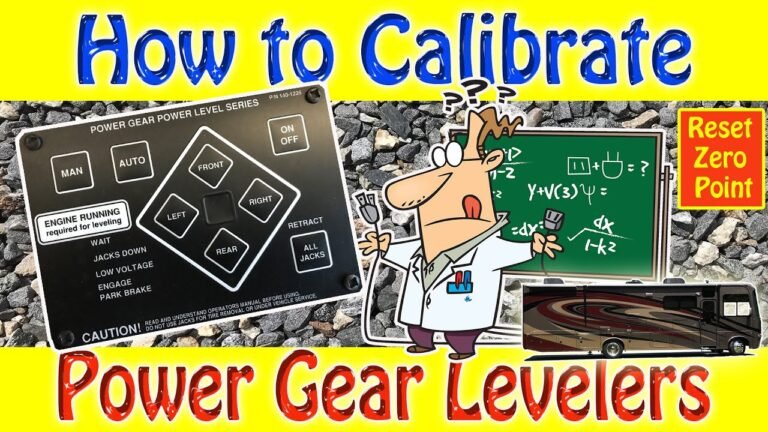
The zero point is the level reference stored by the controller. Automatic leveling uses this reference to decide when the RV is level. If the RV stops noticeably nose-high, nose-low, or tilted side to side, the zero point may be wrong.
Before recalibrating
- Park on a firm, stable surface.
- Use a reliable RV level, not only the control panel display.
- Confirm that the RV is level front to back and side to side.
- Keep the wheels chocked.
- Make sure the jacks are not on soft soil or unstable blocks.
- Follow the exact button sequence in the Lippert manual.
The zero-point procedure is not universal. Some Ground Control panels use a combination of buttons, while other systems use a menu or OneControl interface. Guessing the sequence can put the system into another mode.
General calibration process
The usual process is:
- Manually level the RV using the approved controls.
- Enter the zero-point calibration mode.
- Store the level position.
- Exit the calibration mode.
- Run a controlled automatic-level test.
- Confirm that no wheel is lifted and that the RV remains stable.
Use a bubble level on the RV floor or another surface Lippert identifies as the reference. A level on a countertop may not represent the RV frame accurately.
If the RV cannot hold the stored level position, the problem may be mechanical, sensor-related, or caused by a weak power supply. Calibration cannot repair a bent jack or failing motor.
Lippert Leveling System Makes Noise but Does Not Move
A motor that hums, clicks, or runs without movement provides useful information.
| Noise or symptom | Possible cause | Safe first check |
|---|---|---|
| Single click | Low voltage, relay, motor, or poor connection | Check battery and terminals |
| Repeated clicking | Weak battery or overloaded motor | Stop and check voltage under load |
| Motor runs, jack stays still | Stripped gear or broken drive | Inspect for damage; arrange service |
| Pump runs, cylinders do not move | Low fluid, valve, air, or pump fault | Check for leaks and fluid level |
| Grinding | Damaged gears or binding jack | Stop operating the system |
| Loud hydraulic whine | Low fluid, air, or pump restriction | Stop and inspect for leaks |
Do not continue running a noisy motor to “break it free.” A stalled motor can draw high current and damage the controller, wiring, or motor.
A small amount of normal motor noise is expected. A new grinding sound, sharp squeal, or repeated stall is not a normal operating condition.
The RV Is Level, but the System Will Not Finish
Some systems stop when the controller believes the RV is level, while others complete a programmed sequence for stability. The system may fail to finish because one jack did not reach its expected position or a sensor did not report correctly.
Try this sequence:
- Confirm the RV is stable and no jack is overloaded.
- Check the control panel for a stored error.
- Inspect all jack feet and legs.
- Verify that no jack is on soft soil, a hole, or an unstable block.
- Retract all jacks using the approved command.
- Wait for the system to confirm retraction.
- Start again from a stable position.
If one jack remains partly extended, do not drive the RV. A partially retracted jack can strike the road.
If the system repeatedly stops at the same point, record which jack moves, which jack stops, and the exact screen message. That information can reduce diagnostic time at an RV service center.
What to Do When a Lippert Jack Is Stuck
A stuck jack needs a cautious response. Do not use a truck, pry bar, impact tool, or improvised chain to force it.
First determine whether the jack is extended, retracted, or carrying weight. Keep the RV supported according to the Lippert procedure. If the jack is loaded, forcing it can shift the RV.
For an electric jack:
- Stop pressing the control.
- Check for a bent leg or blocked foot.
- Inspect the motor wire and connector.
- Check battery voltage.
- Use only the approved manual override method.
For a hydraulic jack:
- Stop the pump.
- Look for fluid leaks from a safe position.
- Do not loosen hydraulic fittings under pressure.
- Do not place hands near the cylinder or hose.
- Use the manufacturer’s emergency retraction instructions or call service.
If a jack cannot retract and the RV must be moved, contact an RV technician or roadside service. The technician may need to support the RV, disconnect the motor or hydraulic circuit, and secure the jack before travel.
Common Lippert Leveling Troubleshooting Mistakes
Several common actions can make the problem worse.
Replacing parts before checking power
A new motor will not solve a weak battery, corroded ground, blown fuse, or damaged wire. Test the shared power path first.
Using the wrong fuse
A higher-rated fuse may prevent nuisance blowing, but it removes protection from the wiring. Use the rating listed by Lippert or the RV manufacturer.
Recalibrating on an uneven site
A wrong zero point can make every later automatic cycle inaccurate. Calibrate only when the RV is truly level.
Running the system on soft ground
A jack foot can sink, tilt, or become overloaded. Use only stable surfaces and approved pads or blocks.
Treating stabilizers as lifting jacks
Many trailer stabilizers are designed to reduce movement, not lift the RV. Follow the RV and Lippert instructions for the specific equipment.
Ignoring low battery voltage
The panel may turn on even when the battery cannot supply the current needed by the motors or pump. Test voltage while the system is operating.
Clearing the error repeatedly
A reset may restore operation for one cycle, but it does not fix a bad sensor, binding jack, damaged wire, or hydraulic leak.
When to Call an RV Technician
Professional service is the safer choice when:
- The RV is leaning or moving unexpectedly.
- A jack is bent, cracked, or detached from the frame.
- A hydraulic hose, cylinder, or valve leaks.
- The pump runs but pressure or movement is abnormal.
- Wiring is burned or melted.
- The main fuse blows again after replacement.
- The system has a repeated sensor or communication fault.
- A jack will not retract before travel.
- You need to work under the RV.
- The control board or motor requires replacement.
Give the technician the system name, RV make and model, control-panel message, battery voltage, affected jack, and steps that caused the failure. Photos of connectors, jacks, and error messages can also help.
Use Lippert’s official support resources and the manuals for the exact product. The Lippert support center provides product information, manuals, and service resources. RV manufacturers may also publish system-specific wiring diagrams and procedures.
A Simple Diagnostic Decision Table
Use this table as a starting point, not as a substitute for the exact service manual.
| Symptom | Most useful first checks | Likely next step |
|---|---|---|
| Panel is blank | Battery, disconnect switch, fuse, ground | Test power at the panel and controller |
| All jacks are dead | Main fuse, breaker, battery, controller power | Check shared wiring and controller |
| One jack is dead | Motor connector, local wire, motor, sensor | Compare with a working jack |
| Motor clicks | Battery under load, terminals, ground | Test or replace the weak connection or battery |
| Motor runs but jack does not move | Gear, screw, mechanical binding | Stop use and inspect the jack |
| Hydraulic pump runs without movement | Fluid, leak, valve, air, pump | Follow hydraulic service procedure |
| System stops with timeout | Obstruction, overload, low voltage, sensor | Inspect the affected jack and record the code |
| RV levels incorrectly | Level surface, zero point, sensors | Recalibrate according to the manual |
| Jack will not retract | Obstruction, motor, wiring, hydraulic fault | Do not travel; arrange safe retraction |
Frequently Asked Questions
Why does my Lippert leveling system keep blowing the fuse?
A blown fuse can result from a shorted wire, overloaded motor, seized jack, damaged controller, or incorrect fuse installation. Replace the fuse only with the specified rating. If it blows again, stop troubleshooting under power and have the circuit tested.
Can I manually retract a Lippert leveling jack?
Some Lippert systems provide a manual override, but the method depends on the jack and system model. It may involve a drive socket, motor release, hydraulic procedure, or controller command. Use the exact Lippert manual. Do not improvise with an impact wrench or force a loaded jack.
Why does my Lippert system say “not level” on flat ground?
The RV may not be level at the controller’s reference point, the zero point may be incorrectly stored, or a jack sensor may be reporting the wrong position. Check level with a separate tool, inspect the jacks, and recalibrate only with the correct model procedure.
Can low battery voltage cause a Lippert leveling error?
Yes. Leveling motors and hydraulic pumps draw much more current than small RV accessories. A battery may appear normal at rest but drop too low during operation. Check the battery, cables, ground, and charging system.
Should I lubricate Lippert leveling jacks?
Only lubricate the parts and with the product specified by Lippert for that jack. Some systems have sealed components, while others may require particular maintenance. Excess grease can collect dirt and may not correct a damaged gear or bent leg.
Key Takeaways
- Start with safety, wheel chocks, battery power, fuses, and grounds.
- Identify whether the RV uses an electric or hydraulic Lippert system.
- Use the exact model manual for error codes, resets, and zero-point calibration.
- A single failed jack usually needs a local motor, wire, sensor, or mechanical check.
- Several failed jacks usually point to shared power, ground, controller, or communication issues.
- Never force a stuck jack or work beneath an unsupported RV.
- Do not travel with a jack that is partly extended.
- Call a qualified RV technician for hydraulic leaks, structural damage, burned wiring, repeated fuse failures, or unsafe retraction problems.
Conclusion
Most Lippert RV leveling system problems can be narrowed down by checking the safest and most common causes first: battery voltage, fuse protection, ground connections, blocked jacks, and control-panel messages. Work slowly, record the symptoms, and avoid replacing parts based on a guess.
If the system shows mechanical damage, hydraulic leakage, repeated electrical faults, or an unsafe position, stop using it. The correct repair is less costly than damage caused by forcing a jack or moving an RV with its support system still extended.