
Do I Need Leveling Blocks For RV: Essential Guide
Yes, most RV owners need leveling blocks for safe, steady, and comfortable camping on uneven ground.
Knowing the answer to “do I need leveling blocks for RV?” can save you from a shaky night, a poorly draining shower, or stress on your RV frame. After many RV setup discussions and campsite examples, the rule is simple: blocks are not required at every site, but they are one of the most useful tools for safe and easy leveling.
Why RV leveling matters
An RV should sit as level as possible from side to side and front to back. A small slope may feel harmless, but it can affect sleep, cooking, water flow, refrigerator operation, and the way doors open.
The first part to level is usually side to side. This is because you cannot raise one side of most travel trailers or motorhomes with the tires alone. You drive the low-side tires onto leveling blocks until the RV is close to level.
Leveling front to back comes next. Travel trailers use the tongue jack, while motorhomes may use hydraulic or electric leveling jacks. Stabilizer jacks then reduce movement, but they should not carry the full weight of the RV unless they are designed to do so.
If you are asking, “do I need leveling blocks for RV use?” think of them as a firm base between your tires, jacks, and the ground. They spread weight, reduce sinking, and help your RV stay stable.

Do I need leveling blocks for RV?
In most cases, yes. You may not use them at every campsite, but carrying a set is a smart choice.
You likely need leveling blocks when:
- Your campsite slopes from one side to the other
- The ground is soft, sandy, muddy, or wet
- Your tires or jack may sink into the soil
- Your RV has a manual leveling process
- You want a stable base under the tongue jack or stabilizers
- You camp in places with gravel, grass, or uneven pavement
- You need to raise one side by several inches
You may not need them when the site is already flat, hard, and stable. A level concrete pad may let you set up without blocks. Even then, many campers place a jack pad under each jack to keep the metal foot from touching dirty or wet ground.
The better question is not only, “do I need leveling blocks for RV?” It is also, “what kind of support does my RV need at this site?” Tire leveling blocks, jack pads, and wheel chocks serve different purposes.

What leveling blocks do for an RV
Leveling blocks raise one or more tires or jacks to correct an uneven campsite. They also create a wider, firmer contact area with the ground.
Here are the main benefits:
- Better comfort: A level RV makes beds, tables, and floors feel more natural.
- Safer appliances: Some propane absorption refrigerators need to operate within the manufacturer’s level limits.
- Better drainage: Shower water and sink water flow more reliably when the RV is not tilted.
- Less movement: A solid base helps reduce rocking when people walk inside.
- Less sinking: Blocks spread the load across a wider area.
- Cleaner setup: Jack feet stay out of mud, grass, and standing water.
- Easier packing: A level RV makes slide operation and door alignment more predictable.
Leveling blocks do not repair a weak suspension system or replace proper wheel chocks. They simply help create a stable, level foundation.
That foundation matters. An RV is like a small house on wheels. If the ground under one corner drops, the whole “house” can twist or move.

Types of RV leveling blocks
Not all leveling blocks perform the same job. Choosing the right type makes setup faster and safer.
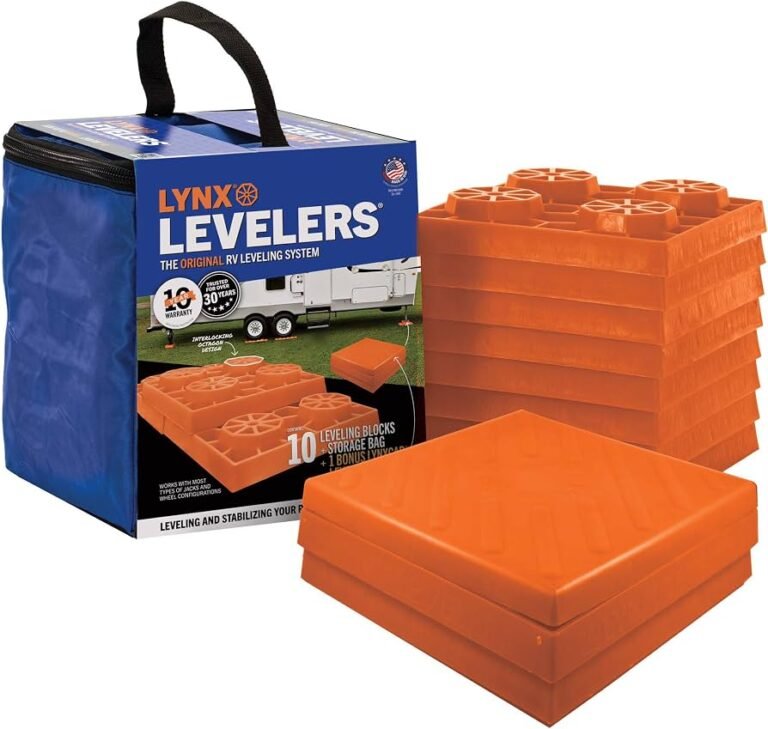
Interlocking leveling blocks
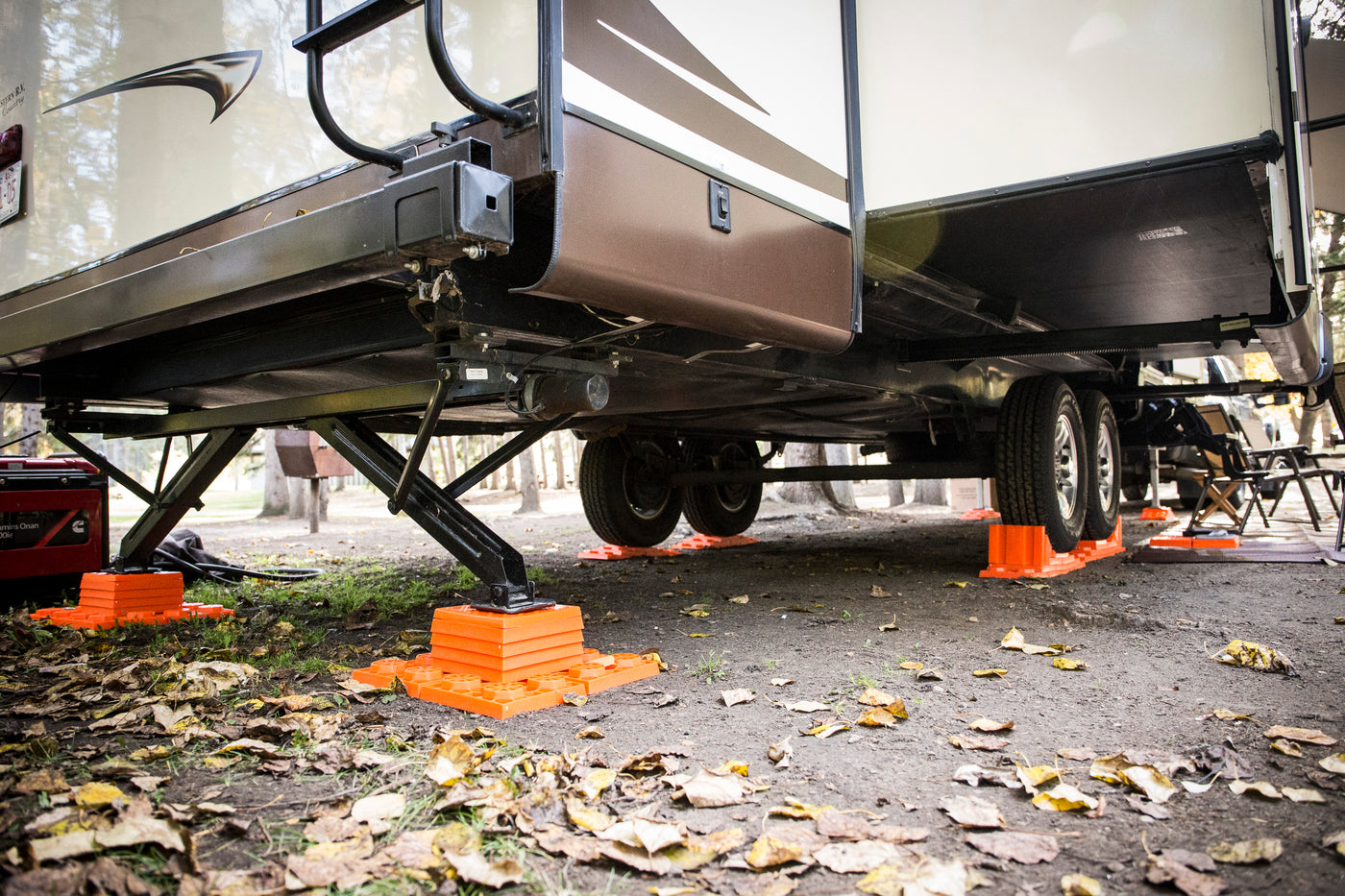
These plastic blocks connect like small building bricks. You can stack them to reach the height you need.
They are popular because they are light, easy to store, and simple to adjust. They work well on firm ground, but cheap plastic can crack under heavy loads or in very cold weather.
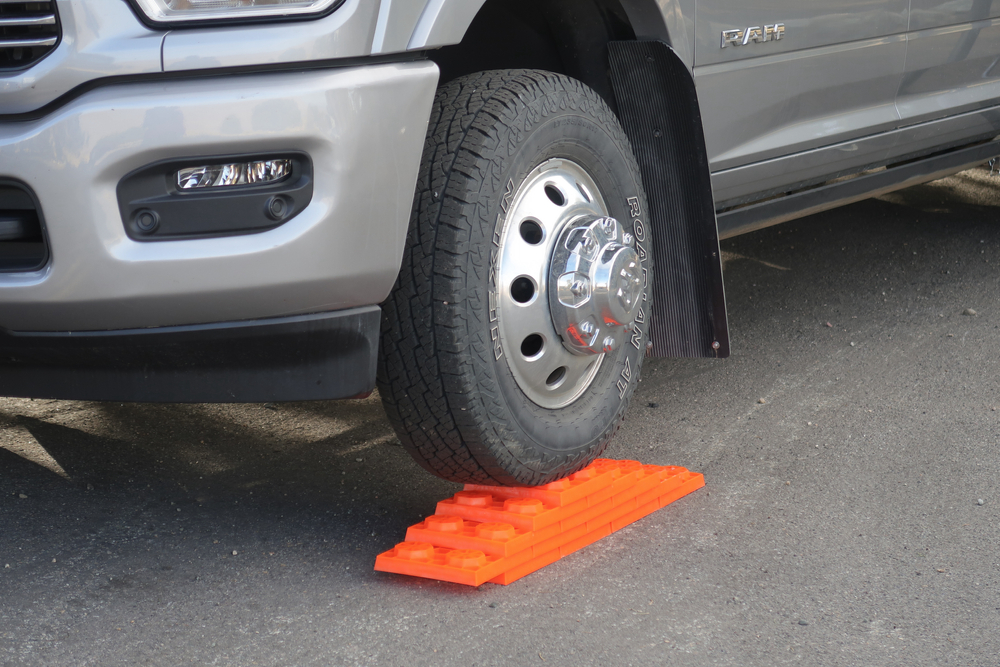
Ramped tire blocks
Ramped blocks let you drive onto a gradual slope. This makes them useful for leveling travel trailers and motorhomes without moving the RV back and forth many times.
Use them with a level placed inside the RV or on a stable floor area. Stop when the RV reaches the correct position, then secure the wheels with chocks.
Andersen-style curved blocks
These curved systems raise the tire as you pull forward. They can make small adjustments quick and smooth.
They are not ideal for every RV. Check the product’s weight rating, tire size limits, and fit before buying.
Wooden leveling blocks
Pressure-treated wood can work well when cut to the right size. Wood is strong and easy to replace, but it is heavy and may split, rot, or slide on smooth surfaces.
If you use wood, inspect it often. Do not use cracked boards or loose scraps that can break under load.
Jack pads
Jack pads sit under stabilizer jacks, hydraulic jacks, or tongue jacks. They are not always designed to level the RV by themselves.
Their main job is to stop jack feet from sinking and to give the jack a stable surface. Some pads are made from hard plastic, while others use thick rubber or composite material.

Leveling blocks versus wheel chocks
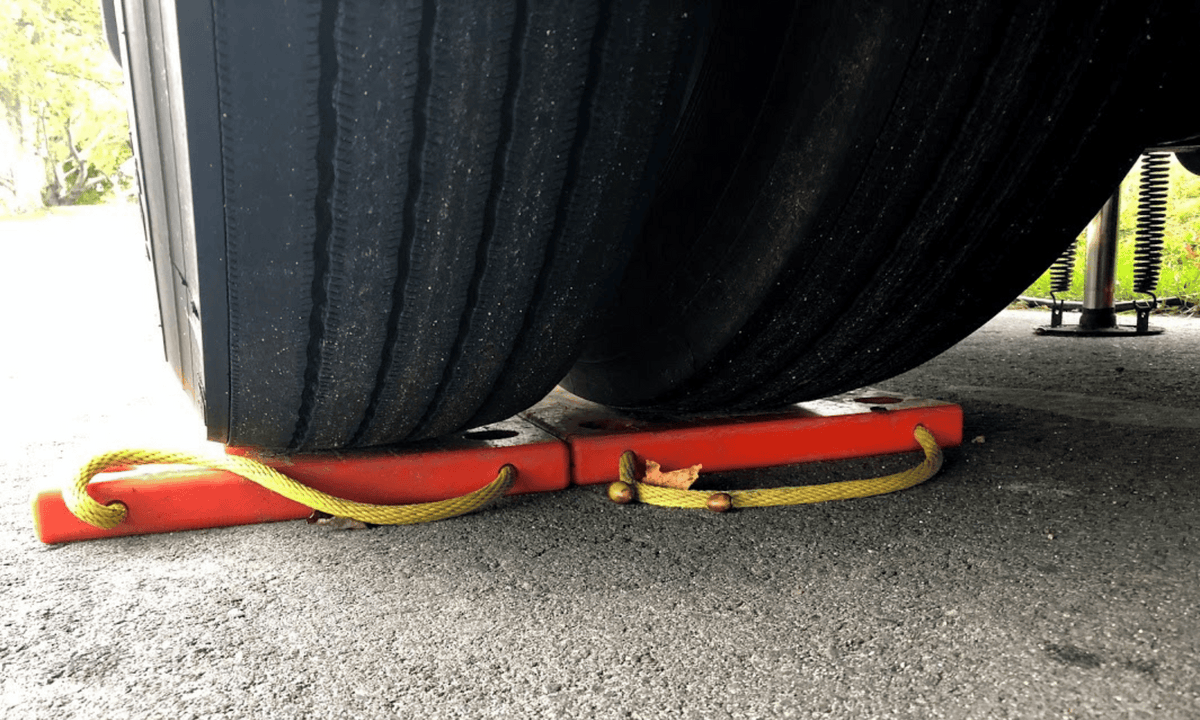
Leveling blocks and wheel chocks are not the same. This is one of the most important safety points for new RV owners.
Leveling blocks raise the RV. Wheel chocks stop the tires from rolling.
Use wheel chocks before disconnecting a trailer from the tow vehicle. Place them snugly against the tires on both sides when possible. After the trailer is connected and stable, use leveling blocks to correct the side-to-side slope.
Never depend on leveling blocks alone to stop an RV from moving. A block can support weight, but it is not a substitute for a proper chock.
A safe basic order is:
- Park in the chosen position.
- Keep the tow vehicle connected if you have a travel trailer.
- Place wheel chocks on both sides of the tires.
- Check the RV level from side to side.
- Pull forward or backward onto leveling blocks if needed.
- Recheck the level.
- Disconnect the trailer if appropriate.
- Level from front to back.
- Lower stabilizers or activate the approved automatic leveling system.
- Check the RV again before extending slides.
This process answers “do I need leveling blocks for RV?” in a practical way. You need them whenever the tires or jacks require extra height or ground support.
How to level a travel trailer with blocks
Travel trailers often need leveling blocks because their axles cannot move independently from side to side. The low side must be raised by driving the tires onto blocks.
Start by placing a small level inside the trailer. Many owners use a two-way bubble level near the refrigerator or on the floor. A level mounted near the front can also help, but the floor is usually more useful for judging comfort.
Next, place the blocks in front of the tires on the low side. Build a smooth ramp if you use separate blocks. Avoid a tall stack with a narrow top because it can be unstable.
Drive onto the blocks slowly. Stop when the trailer is level from side to side. Set the parking brake, place the chocks, and then disconnect the trailer if the setup is safe.
Use the tongue jack to level the trailer from front to back. Once level, lower the stabilizer jacks onto pads. The stabilizers should steady the trailer, not lift the tires off the blocks.
A common mistake is to use the stabilizers to raise the trailer. That can bend equipment, damage mounting points, or create an unstable setup.

How to level a motorhome with blocks
Motorhomes may use leveling blocks under tires, jack feet, or both. The right method depends on the chassis and the manufacturer’s instructions.
For a motorhome without an automatic hydraulic system, drive the low-side tires onto ramp blocks. Set the parking brake and use wheel chocks if the site slope requires them.
For a motorhome with hydraulic leveling jacks, place jack pads or blocks beneath the jack feet when the ground is soft. Some systems can lift the coach, but the jacks should remain within their approved extension range.
Never crawl under a motorhome supported only by hydraulic or electric jacks. Systems can lose pressure or power. If you must work beneath the vehicle, use properly rated mechanical supports and follow professional safety procedures.
If you are still wondering, “do I need leveling blocks for RV motorhome use?” check your owner’s manual. Some motorhomes need blocks for ground protection, while others need them to keep the jacks within a safe operating range.
How level does an RV need to be?
An RV does not need to be perfectly level like a laboratory table. It should be level enough for comfort and for appliances to operate within their safe limits.
A small bubble movement may not matter. A strong slope that makes cabinet doors swing, water pool in the shower, or people feel off balance deserves correction.
Refrigerator requirements vary by model. Older propane absorption refrigerators can be sensitive to extended operation while significantly out of level. Modern units still have limits, so follow the manual rather than relying on a general rule.
A smartphone level can help, but it may not show the exact angle of the RV floor. Use it as a guide, then confirm with the appliance instructions and your own comfort.
The practical answer to “do I need leveling blocks for RV?” is based on the amount of correction needed. Small differences may be fine. A visible or uncomfortable tilt should be fixed.

How many leveling blocks do I need?
Most RV owners should carry enough blocks for both tire leveling and jack support. The exact number depends on your RV type, axle layout, block design, and camping style.
A basic kit often includes:
- Ten to twelve interlocking blocks
- Two to four jack pads
- Two or more pairs of wheel chocks
- A small bubble level
- A storage bag or plastic container
A tandem-axle travel trailer may need a longer ramp under both tires on the low side. A motorhome may need blocks under several jack feet.
Do not assume that more blocks always mean more safety. Stacked blocks must remain flat, aligned, and within the product’s rated height. A tall, crooked stack can shift under load.
Check the load rating for each block. The total RV weight is not always spread evenly, so consider the load on each tire or jack. When uncertain, choose a product with a generous safety margin.
Common mistakes to avoid
Many RV setup problems come from rushing the first five minutes. A careful routine prevents most of them.
Avoid these mistakes:
- Using leveling blocks as wheel chocks
- Placing blocks on loose mud or deep sand without a firm base
- Building an uneven or leaning stack
- Driving off the edge of a block
- Using cracked wood or damaged plastic
- Raising tires too far from the ground
- Lifting the RV with stabilizer jacks
- Ignoring the RV manufacturer’s jack instructions
- Extending slide-outs before leveling
- Forgetting to recheck the level after opening slides
- Leaving the tow vehicle disconnected before the trailer is secure
- Working beneath a vehicle supported only by jacks
One lesson experienced campers often learn the hard way is that a fast setup can become a long repair. Take an extra minute to inspect each contact point and confirm that the RV is stable.
Choosing the best RV leveling blocks
The best blocks match your RV weight, tire size, ground type, and travel habits. A small pop-up camper does not need the same system as a large diesel pusher.
Look for these features:
- A clear weight rating
- A wide, stable footprint
- A surface that resists tire movement
- Interlocking points or a secure ramp shape
- UV-resistant material
- Easy storage
- A design that fits your tire width
- A height that matches your normal campsite needs
Plastic blocks are often the best choice for casual campers because they are light and clean. Heavy-duty composite blocks suit frequent travelers. Wood can be strong but requires more care.
Read the product instructions before stacking blocks. Some products allow only a certain number of layers. Never assume that two products with a similar shape have the same strength.
Do leveling blocks damage RV tires?
Properly used leveling blocks should not damage RV tires. Damage is more likely when a tire sits on a sharp edge, climbs onto a crooked block, or remains partly supported for a long time.
Place the tire fully on the block. Keep the tire centered and avoid contact with sharp corners. Inspect blocks before each trip.
Do not use a thin board that can split under the tire. Do not place loose rocks under a tire. Rocks can shift, cut rubber, or create an unstable surface.
Tire pressure also matters. Use the pressure listed for your RV’s actual load, based on the tire and vehicle manufacturer’s guidance. Overinflation and underinflation can both create handling and wear problems.
What to carry in an RV leveling kit
A useful leveling kit should cover leveling, chocking, measuring, and ground protection.
Pack:
- Leveling blocks
- Wheel chocks
- Jack pads
- A bubble level
- Work gloves
- A small brush for cleaning blocks
- A flashlight or headlamp
- A storage tote
- A spare set of blocks for emergencies
A tape measure can help when planning a ramp. A cordless drill and socket may help with stabilizer jacks, but only use tools approved by the equipment maker.
Keep the kit where you can reach it before fully opening the RV. It is frustrating to unload half the storage bay just to find one small block.
Frequently Asked Questions About Do I Need Leveling Blocks for RV
Do I need leveling blocks for RV camping on concrete?
Not always. A flat concrete pad may provide enough support, but jack pads can still protect the surface and keep jack feet from slipping or getting dirty.
Can I use leveling blocks under RV tires?
Yes. Tire-rated leveling blocks can raise the low side of a travel trailer or motorhome. Make sure the tire sits fully on the block and that the product supports your RV’s load.
Do leveling blocks replace wheel chocks?
No. Leveling blocks raise the RV, while wheel chocks prevent movement. Use both when needed, especially before disconnecting a travel trailer.
Do I need leveling blocks for RV stabilizer jacks?
You may need them when the ground is soft, uneven, or wet. Jack pads and blocks help prevent sinking, but they do not replace proper leveling procedures.
Can I level an RV with the stabilizer jacks?
Stabilizer jacks are mainly designed to reduce movement after the RV is level. Using them to lift the RV can damage the jacks, frame, or mounting points.
How high can I stack RV leveling blocks?
Use the maximum stack height listed by the manufacturer. A low, wide, well-aligned stack is safer than a tall stack that can tilt or slide.
Are wooden blocks safe for RV leveling?
They can be safe when they are thick, sound, level, and properly rated for the load. Replace boards that are cracked, warped, rotten, or split.
Conclusion
So, do I need leveling blocks for RV travel? You may not use them at every campsite, but they are worth carrying on nearly every trip. They help level tires, support jacks, protect soft ground, and make your RV safer and more comfortable.
Use leveling blocks with wheel chocks, follow your owner’s manual, and never use stabilizers as lifting jacks unless the system is designed for that job. Pack a complete kit before your next trip, test your setup at home, and share your favorite RV leveling tips in the comments.