Leveling RV Refrigerator: Easy Guide For Safe Cooling
A level RV refrigerator cools more safely, works more evenly, and helps prevent costly damage to the cooling unit.
Leveling an RV refrigerator is not the same as leveling the whole motorhome. The refrigerator needs a fairly level position so its ammonia solution can move through the cooling system as designed. This guide explains how level your RV should be, how to check it, what can go wrong, and how to avoid common safety mistakes.
Why Leveling an RV Refrigerator Matters
Most RV refrigerators use an absorption cooling system. This system has no standard compressor. Instead, it uses heat, ammonia, water, and hydrogen gas to move heat out of the refrigerator.
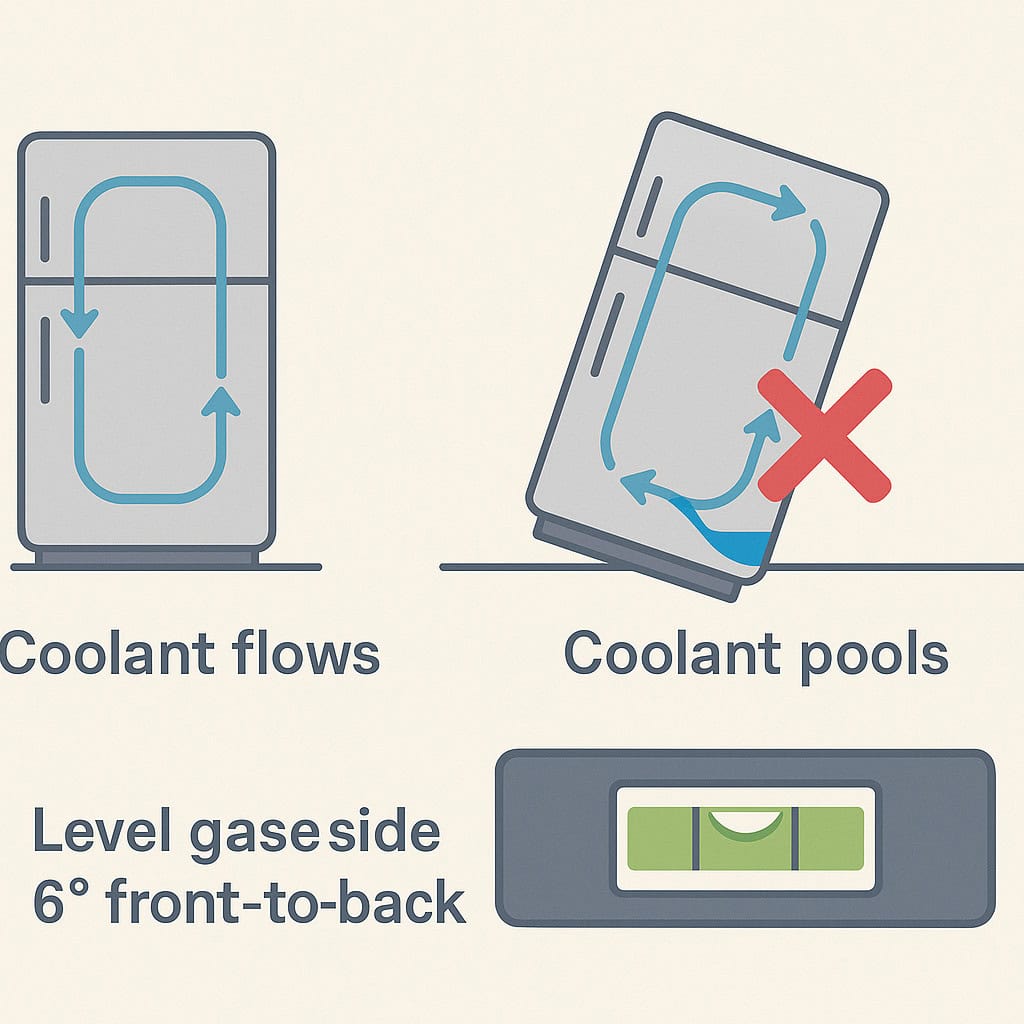
The cooling solution must flow through small tubes by gravity and natural circulation. When the RV sits too far off level, the fluid can slow down or stop. Hot spots may then form inside the cooling unit.
That is why leveling an RV refrigerator is more than a comfort issue. It protects cooling performance and may extend the life of the refrigerator.
An RV refrigerator may still seem to work when it is off level. This can be misleading. Damage can build slowly, much like driving a car with low oil. You may not notice the problem until the cooling unit fails.
Important reasons to level an RV refrigerator include:
• Better cooling in the freezer and fresh-food sections
• Lower stress on the cooling unit
• Less chance of overheating in the boiler area
• More even temperature control
• Safer operation when using propane or electric heat
RV manufacturers and refrigerator makers often use a small tolerance, commonly around 3 degrees side to side and 6 degrees front to back. These numbers vary by model, so your refrigerator owner’s manual should always be the final guide.
How Level Does an RV Refrigerator Need to Be?
Your RV refrigerator does not need to be perfectly level like a laboratory table. It needs to stay within the operating range listed by the manufacturer.
Many absorption refrigerator manuals describe the acceptable range as about 3 degrees from side to side and 6 degrees from front to back. Some newer models have different limits. A digital level can help, but do not rely on a general rule when your manual gives a specific measurement.
The refrigerator itself matters more than the floor near the entry door. Your RV may feel level while the refrigerator cabinet is not. The best place to measure is:
• On a flat shelf inside the refrigerator
• On the refrigerator frame
• On the freezer floor, if it is stable and safe
• On the outside trim, when the trim matches the refrigerator cabinet
Avoid measuring on a curved counter, soft shelf, or loose storage bin. These surfaces can give a false reading.
A useful rule is simple: level the RV enough for the refrigerator, then check the refrigerator directly. This small step can prevent guesswork.
For compressor RV refrigerators, leveling is usually less critical. A compressor can often run when the RV is mildly tilted, but the manufacturer may still require a certain position for oil return and safe operation.

How to Check an RV Refrigerator for Level
Checking the refrigerator takes only a few minutes. A small bubble level works well, while a digital level gives a more exact reading.
Follow these steps:
-
Park the RV on a firm surface.
-
Set the parking brake and use wheel chocks.
-
Open the refrigerator door and remove items that may move.
-
Place the level on a flat shelf or refrigerator floor.
-
Check from side to side.
-
Turn the level 90 degrees and check from front to back.
-
Compare the reading with the refrigerator manual.
-
Adjust the RV with leveling blocks or the built-in leveling system.
-
Recheck the refrigerator after each adjustment.
When I check an RV, I look at the refrigerator first rather than trusting the coach floor. A common mistake is to level the campsite by eye. The road, gravel, and tires can make a small slope look harmless, but the refrigerator may still sit outside its safe range.
Do not place a level on a shelf loaded with food. Weight can bend the shelf or change the reading. Use a firm surface and keep the test simple.
A smartphone level app can help in an emergency. However, phone sensors may need calibration, and the case can affect the reading. Use a real bubble or digital level when possible.
How to Level an RV Refrigerator at a Campsite
Leveling an RV refrigerator starts with choosing the best parking position. Look for a firm, stable site with minimal slope. Avoid soft shoulders, deep gravel, and areas where one wheel could sink overnight.
If your motorhome has hydraulic or electric leveling jacks, use them according to the vehicle manual. Do not use the jacks to lift wheels off the ground unless the manufacturer specifically allows it.
For a travel trailer or fifth wheel, use leveling blocks under the low side wheels. Pull forward or backward onto the blocks until the side-to-side reading improves. Then disconnect or adjust the hitch as needed and correct the front-to-back angle with the tongue jack or landing gear.
A practical order is:
-
Check the campsite before parking.
-
Level side to side with wheel blocks.
-
Secure the wheels with chocks.
-
Level front to back.
-
Place a level inside the refrigerator.
-
Fine-tune the position.
-
Recheck after opening slides or moving inside the RV.
Slides can slightly change how an RV sits, especially on soft ground. For that reason, check the refrigerator again after the RV is fully set up.
Never place loose wood, rocks, or unstable objects under a tire. Use rated leveling blocks made for RV loads. A stable base protects the tires, suspension, jacks, and refrigerator at the same time.

Leveling an RV Refrigerator While Driving
You cannot safely fine-tune the refrigerator level while driving. The RV moves, leans, and vibrates too much for a useful reading.
The best approach is to keep the RV refrigerator within a reasonable range while traveling and avoid long stops on steep slopes. A short rest stop on a mild grade is usually different from leaving the refrigerator running for many hours on a sharp side slope.
If you must park on an incline, try to position the RV so the refrigerator stays within the manufacturer’s allowed range. Do not place the RV in an unsafe position just to protect the refrigerator. Traffic, wheel stability, weather, and emergency access come first.
Some owners turn off an absorption refrigerator before traveling. Others use the refrigerator’s approved travel mode, such as propane or electric operation, where legal and safe. Follow local laws and the refrigerator manual.
Never operate propane appliances in places where propane use is prohibited. Turn off propane before entering tunnels, fueling areas, and other restricted locations.
What Happens When an RV Refrigerator Is Off Level?
An off-level refrigerator may show several warning signs. The freezer may remain cold while the fresh-food section warms. You may also notice longer heating cycles, unusual odors, error codes, or a refrigerator that cools only at certain times.
In an absorption refrigerator, poor leveling can restrict the flow of the ammonia solution. The boiler may continue producing heat even when the fluid does not circulate well. This can create excessive heat in one area of the cooling unit.
Possible problems include:
• Weak or uneven cooling
• Higher propane or electrical use
• A failed cooling unit
• Dark yellow residue near the cooling unit
• A sharp ammonia smell
• A tripped high-temperature safety device
• Fire risk in severe cases
If you smell ammonia, see yellow residue, or notice scorching near the refrigerator, turn the refrigerator off. Shut off the propane supply if it is safe to do so, leave the area, and contact a qualified RV technician.
Do not keep resetting a safety device or repeatedly restarting a refrigerator that shows signs of overheating. A safety device is a warning, not a problem to ignore.

Leveling an RV Refrigerator: Absorption Versus Compressor Models
The correct leveling method depends on the refrigerator design. Most RV refrigerators fall into two groups: absorption and compressor.
Absorption RV refrigerators
Absorption models often run on propane, 120-volt AC power, or both. They need careful leveling because gravity helps move the cooling fluids through the system.
For these units:
• Follow the exact leveling range in the manual.
• Avoid long operation on steep slopes.
• Keep air vents clear.
• Watch for heat buildup behind the refrigerator.
• Stop using the unit if you see signs of a cooling-unit leak.
Compressor RV refrigerators
Compressor models work more like household refrigerators. They use a motor-driven compressor and refrigerant. They are usually more tolerant of mild movement, but they still need proper installation and airflow.
For compressor models:
• Allow the refrigerator to stand upright after a major tilt.
• Follow the manufacturer’s instructions after transport.
• Keep the rear ventilation area clear.
• Check that the doors close and seal correctly.
• Use the specified power supply and fuse.
A common mistake is treating every RV refrigerator the same. The safest leveling RV refrigerator method is always the one designed for that specific model.

Tools That Make Leveling Easier
You do not need a large tool kit. A few simple items can make leveling faster and more accurate.
Useful tools include:
• A small bubble level
• A digital angle finder
• A smartphone level app as a backup
• Interlocking RV leveling blocks
• Wheel chocks
• A tape measure
• The refrigerator owner’s manual
• A notebook or phone note for recording readings
Marking the refrigerator’s level point can also help. For example, you can place a small removable label near the shelf where you usually measure. This makes future checks quick and consistent.
Do not permanently attach a level unless the refrigerator maker approves it. Adhesive can damage trim, and a level mounted on a crooked surface may create false confidence.
If your RV uses automatic leveling, let the system complete its cycle before checking. Then measure the refrigerator itself. Automatic jacks level the coach based on their sensors, not always the refrigerator cabinet.
Common Mistakes to Avoid
Small mistakes can lead to poor cooling or equipment damage. The most common problem is assuming that a comfortable RV is a level refrigerator.
Avoid these errors:
• Measuring the floor instead of the refrigerator
• Using a soft or curved surface for the level
• Ignoring the owner’s manual
• Running an absorption refrigerator for hours on a steep slope
• Blocking the outside vents
• Covering the inside air vents with food
• Using unstable objects under the tires
• Continuing to run the refrigerator after an ammonia leak
• Resetting safety controls without finding the cause
• Leaving the refrigerator door slightly open
Food safety matters too. The USDA recommends keeping a refrigerator at 40°F or below and a freezer at 0°F. Use a refrigerator thermometer instead of judging food safety by touch.
If the refrigerator cannot hold a safe temperature after proper leveling, the problem may involve airflow, a bad thermistor, weak door seals, low voltage, a burner issue, or a failing cooling unit.
Troubleshooting After Leveling an RV Refrigerator
Proper leveling is important, but it is only one part of refrigerator care. If the unit still does not cool, check the simple causes first.
The refrigerator is warm
Check the power source, circuit breaker, propane supply, and outside ventilation. Confirm that the doors seal and that food is not blocking the internal air path.
The freezer works but the fresh-food section is warm
This may point to poor air circulation, a blocked vent, a bad thermistor, or frost buildup. Do not pack food tightly against the cooling fins.
The refrigerator shows an error code
Write down the code and check the manual. Turn the unit off if instructed, but do not keep restarting it if the code returns.
The burner will not stay lit
Look for low propane pressure, wind at the outside vent, dirt near the burner, or a blocked flue. Gas work should be handled by a qualified technician.
The refrigerator gets hot outside
Some heat is normal, especially near the upper vent. Excessive heat, burning smells, discoloration, or melted plastic requires immediate attention.
In my experience, owners often adjust the level again and again when the real problem is blocked ventilation. Leveling an RV refrigerator helps the cooling process, but it cannot fix a damaged cooling unit or a failed control board.
When to Call an RV Refrigerator Technician
Call a qualified RV technician when the refrigerator leaks, overheats, repeatedly shuts down, or fails to cool after basic checks.
Professional service is especially important when you notice:
• A strong ammonia odor
• Yellow powder or liquid near the cooling unit
• Soot around the burner
• Burned wiring or melted connectors
• Repeated high-temperature shutdowns
• A cooling unit that remains warm after many hours
• Propane odors
• Electrical faults or damaged fuses
An RV refrigerator combines gas, electricity, heat, and chemicals. It is not a good place to experiment with bypass wires or homemade repairs.
A trained technician can test gas pressure, burner operation, ventilation, thermistors, control boards, and cooling-unit performance. Ask for a clear explanation of the fault and the repair cost before approving major work.
If the cooling unit has failed, compare the cost of replacement with the age and condition of the refrigerator. Sometimes a new cooling unit makes sense. In other cases, replacing the refrigerator is the better long-term choice.
Frequently Asked Questions About Leveling an RV Refrigerator
How level does an RV refrigerator need to be?
Many absorption RV refrigerators allow about 3 degrees side to side and 6 degrees front to back, but the exact range depends on the model. Always use the owner’s manual as the final authority.
Can an RV refrigerator run when the RV is not level?
It may run, but long operation while significantly off level can reduce cooling and damage the cooling unit. Level the RV as soon as it is safely possible.
Should I level the RV or the refrigerator?
Level the RV first, then check the refrigerator directly. The refrigerator cabinet is the surface that matters most for safe operation.
How long can an RV refrigerator run off level?
There is no safe universal time limit because slope, model, temperature, and operating mode vary. Avoid running an absorption refrigerator for long periods when it is outside the manufacturer’s leveling range.
Can I use a smartphone to check RV refrigerator level?
Yes, a phone app can provide a useful estimate. Calibrate the phone and place it on a firm, flat surface, but use a physical level for more dependable results.
Does leveling matter for a compressor RV refrigerator?
It usually matters less than it does for an absorption model. However, compressor refrigerators still need correct installation, airflow, and the level limits listed by the manufacturer.
Why is my RV refrigerator still warm after leveling?
Check power, propane, ventilation, door seals, frost, food placement, and the temperature sensor. If it remains warm after these checks, have a qualified RV technician inspect it.
Conclusion
Leveling an RV refrigerator protects the cooling system, improves temperature control, and supports safer RV travel. Check the refrigerator itself, use stable leveling blocks, follow the manufacturer’s limits, and never ignore ammonia odors, yellow residue, or overheating.
Make refrigerator leveling part of your normal campsite setup. A small level and a few extra minutes can prevent spoiled food and a very expensive repair. For more RV maintenance tips, explore trusted service manuals, save this guide, and share your own leveling experience in the comments.